


There are Maisons that follow tradition and others that reinterpret it. Jacquesson belongs to the rarest category: those that transcend it. The philosophy of the Chiquet family – “Why aim for average when you can achieve excellence?” – is not a slogan, but a method: rejection of standardization, centrality of terroir, and the use of time as a true creative tool.
Located in Dizy, in the heart of the Vallée de la Marne, Jacquesson has represented for decades a model of coherence, rigor and authorial viticulture. Since December 2022 it has been part of Artémis Domaines, a group that has chosen to support and enhance its identity without altering its essence. Operational leadership is entrusted to Jean Garandeau, supported by Yann Le Gall, chef de cave, and Mathilde Prier, head of viticulture. Among the innovations introduced, the new Coquart press allows even more precise parcel-by-parcel selections, projecting the Maison into a new evolutionary phase.
The vision of brothers Jean-Hervé and Laurent Chiquet, at the helm since 1988, remains the foundation of the project: reduced yields, parcel valorization, grass cover, drastic reduction of chemical treatments and harvesting only at perfect ripeness. The 31 hectares are now cultivated according to a reasoned agriculture, with organic compost and minimal interventions. In the cellar, the philosophy of “less is more” prevails: spontaneous fermentations, natural malolactic fermentation, ageing in 42 hl barrels with bâtonnage, no racking or filtration, natural clarification and low use of sulfur dioxide.
The year 2000 marks a turning point with the birth of Cuvée 728, the first of a numbered series that tells the story of each vintage. With the 700 series, Jacquesson redefines the concept of Brut sans année: each parcel is vinified separately and the assemblage aims to express the essence of the vintage, supported by reserve wines kept in demi-muids. Numbering the cuvées becomes an act of transparency and identity, because every vintage deserves to be recognized.
Pietro Pellegrini recalls how Jean-Hervé Chiquet was the first to speak to him about “Grande Vino di Champagne”, a concept that continues to live in every new cuvée of the Maison.
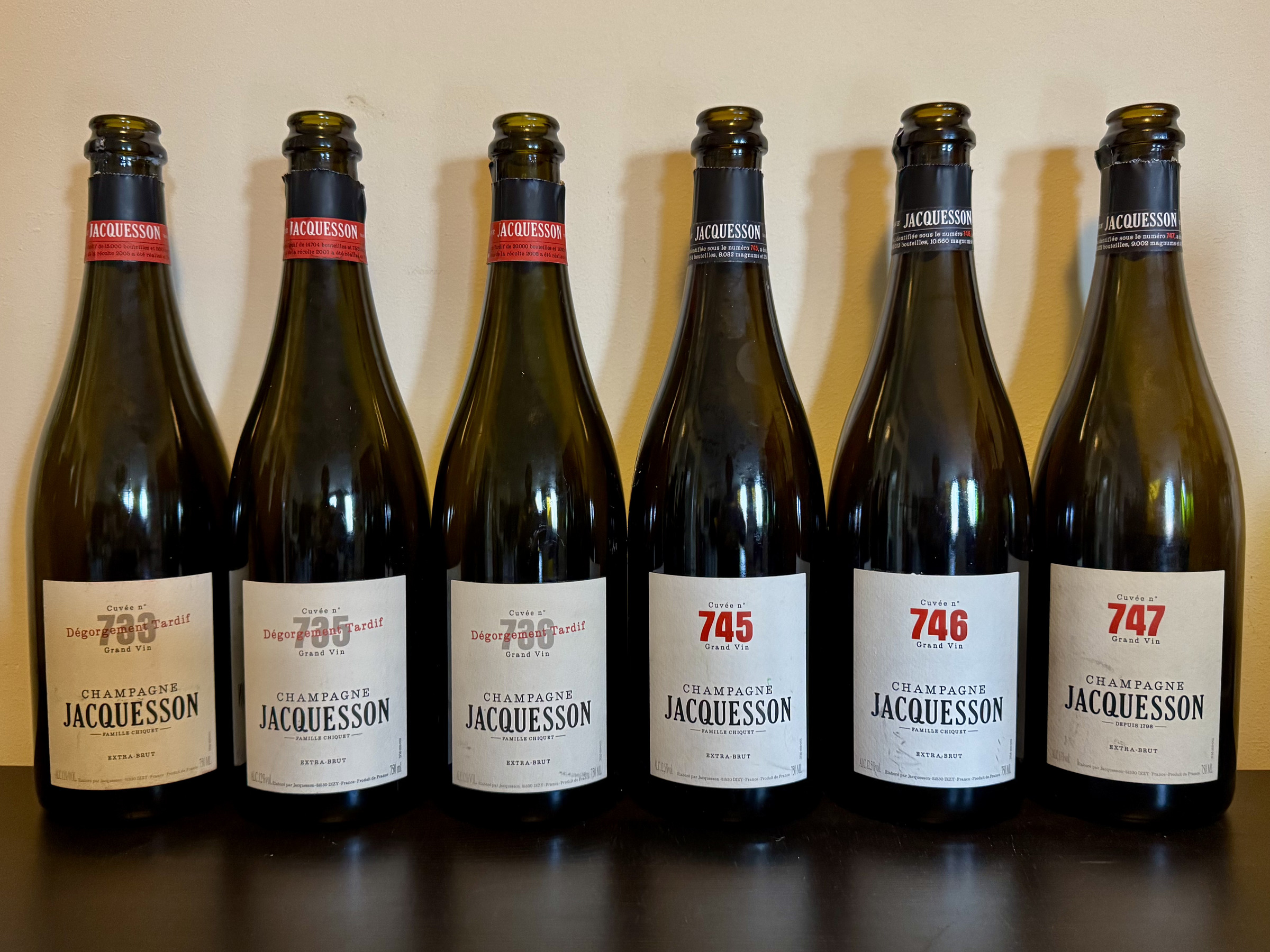
The masterclass made it possible to read this identity through two complementary chapters. On the one hand, Cuvées 733, 735 and 736 Dégorgement Tardif: rare expressions of extended time, capable of showing how the material can transform and stratify, revealing unexpected depth. On the other, Cuvées 745, 746 and 747: Jacquesson’s contemporaneity, recent vintages interpreted with rigor, agronomic sensitivity and a constant pursuit of purity and precision.
A journey that showed how the Maison is able to maintain stylistic coherence across very different vintages, and how each cuvée becomes a tile in a larger mosaic: that of an authentic, energetic and identity-driven Champagne. An evening that demonstrated, glass after glass, how time can truly become art.
Cuvée 733 – Dégorgement Tardif
Cuvée 733 Dégorgement Tardif originates from the 2005 harvest, with the addition of 22% reserve wines from Grand and Premier Cru vineyards of the Grande Vallée de la Marne and the Côte des Blancs. The assemblage combines 52% Chardonnay, 24% Pinot Noir and 24% Meunier. Ageing took place with extended sur lattes maturation, culminating in a dégorgement tardif in October 2013. The dosage is Extra Brut, 2.5 g/l, for a production of 15,000 bottles and 800 magnums.
The profile is citrus-driven, with lemon and cream intertwining with a vinous, enveloping and very fine substance. Evolved notes of humus then emerge, followed by accents of licorice, coffee, balsamic and herbal nuances, expanding depth and complexity. Hints of dried fruit and candied orange peel are also perceived, together with a chalky minerality that provides lift and definition. The structure remains broad yet supported by subtle freshness, which extends the finish with elegance and precision.
Cuvée 733 Dégorgement Tardif originates from the 2005 harvest, with the addition of 22% reserve wines from Grand and Premier Cru vineyards of the Grande Vallée de la Marne and the Côte des Blancs. The assemblage combines 52% Chardonnay, 24% Pinot Noir and 24% Meunier. Ageing took place with extended sur lattes maturation, culminating in a dégorgement tardif in October 2013. The dosage is Extra Brut, 2.5 g/l, for a production of 15,000 bottles and 800 magnums.
The profile is citrus-driven, with lemon and cream intertwining with a vinous, enveloping and very fine substance. Evolved notes of humus then emerge, followed by accents of licorice, coffee, balsamic and herbal nuances, expanding depth and complexity. Hints of dried fruit and candied orange peel are also perceived, together with a chalky minerality that provides lift and definition. The structure remains broad yet supported by subtle freshness, which extends the finish with elegance and precision.
Cuvée 735 – Dégorgement Tardif
Cuvée 735 Dégorgement Tardif is based on the 2007 vintage, enriched by 28% reserve wines from Grand and Premier Cru vineyards of the Grande Vallée de la Marne and the Côte des Blancs. The assemblage is composed of 47% Chardonnay, 33% Pinot Noir and 20% Meunier. The wine rested for over 7 years sur lattes, with dégorgement tardif in November 2015. The dosage is 3.5 g/l, for a production of 14,704 bottles and 758 magnums.
The aromatic profile is creamy, dynamic and fresh, with references to caramel toffee, citrus and lemon. The palate is juicy and saline, with a buttery patina that integrates with the mineral component. A licorice vein closes the picture with elegance. Nuances of dried fruit and candied citrus peel are added, together with a chalky tension that gives verticality. The finish is precise and luminous, with subtle energy that perfectly reflects the style of the cuvée in its late-disgorged version.
Cuvée 735 Dégorgement Tardif is based on the 2007 vintage, enriched by 28% reserve wines from Grand and Premier Cru vineyards of the Grande Vallée de la Marne and the Côte des Blancs. The assemblage is composed of 47% Chardonnay, 33% Pinot Noir and 20% Meunier. The wine rested for over 7 years sur lattes, with dégorgement tardif in November 2015. The dosage is 3.5 g/l, for a production of 14,704 bottles and 758 magnums.
The aromatic profile is creamy, dynamic and fresh, with references to caramel toffee, citrus and lemon. The palate is juicy and saline, with a buttery patina that integrates with the mineral component. A licorice vein closes the picture with elegance. Nuances of dried fruit and candied citrus peel are added, together with a chalky tension that gives verticality. The finish is precise and luminous, with subtle energy that perfectly reflects the style of the cuvée in its late-disgorged version.
Cuvée 736 – Dégorgement Tardif
Cuvée 736 Dégorgement Tardif is based on the 2008 vintage, with ageing of 88 months sur lie. The grapes come from the villages of Aÿ, Dizy, Hautvillers, Avize and Oiry, together with reserve wines. Viticulture is respectful of soil and vine, serving parcel diversity. Vinification takes place in foudre sur lies, without filtration or fining. The dégorgement tardif occurred in November 2016, with a dosage of 1.5 g/l, sulfites below 40 mg/l and tirage capsule. Production totals 20,000 bottles and 1,000 magnums.
The tasting immediately reveals the depth of the 2008 vintage and the complexity brought by long ageing. It shows riper fruit, with notes of citrus, mandarin, a strong mineral imprint and a patina that enriches the texture. The overall impression is one of great verticality and precision. Nuances of dried fruit and candied peel also emerge, together with the chalky tension typical of the 2008 vintage. Aromatic depth develops with elegance, supported by incisive freshness that extends the finish in a clean and crystalline manner.
Cuvée 736 Dégorgement Tardif is based on the 2008 vintage, with ageing of 88 months sur lie. The grapes come from the villages of Aÿ, Dizy, Hautvillers, Avize and Oiry, together with reserve wines. Viticulture is respectful of soil and vine, serving parcel diversity. Vinification takes place in foudre sur lies, without filtration or fining. The dégorgement tardif occurred in November 2016, with a dosage of 1.5 g/l, sulfites below 40 mg/l and tirage capsule. Production totals 20,000 bottles and 1,000 magnums.
The tasting immediately reveals the depth of the 2008 vintage and the complexity brought by long ageing. It shows riper fruit, with notes of citrus, mandarin, a strong mineral imprint and a patina that enriches the texture. The overall impression is one of great verticality and precision. Nuances of dried fruit and candied peel also emerge, together with the chalky tension typical of the 2008 vintage. Aromatic depth develops with elegance, supported by incisive freshness that extends the finish in a clean and crystalline manner.
Cuvée 745
Cuvée 745 interprets the 2017 vintage, characterized by a cold and dry spring followed by a hot and rainy summer. The grapes come 66% from Aÿ, Dizy and Hautvillers, and 34% from Avize and Oiry, with the addition of reserve wines. Vinification and ageing take place in foudre sur lies, without filtration or fining. Sulfites are below 40 mg/l. Dégorgement occurred in November 2021, with a dosage of 0.75 g/l. Technical cork. Production amounts to 206,164 bottles, 8,082 magnums and 250 jeroboams.
The tasting profile is fine and light, with agile and luminous drinkability, faithful to the vintage. Notes of fresh citrus and white flowers emerge, together with a chalky minerality that provides lift and precision. The structure remains slender and taut, with a saline and clean finish that perfectly reflects the more delicate and linear nature of 2017.
Cuvée 745 interprets the 2017 vintage, characterized by a cold and dry spring followed by a hot and rainy summer. The grapes come 66% from Aÿ, Dizy and Hautvillers, and 34% from Avize and Oiry, with the addition of reserve wines. Vinification and ageing take place in foudre sur lies, without filtration or fining. Sulfites are below 40 mg/l. Dégorgement occurred in November 2021, with a dosage of 0.75 g/l. Technical cork. Production amounts to 206,164 bottles, 8,082 magnums and 250 jeroboams.
The tasting profile is fine and light, with agile and luminous drinkability, faithful to the vintage. Notes of fresh citrus and white flowers emerge, together with a chalky minerality that provides lift and precision. The structure remains slender and taut, with a saline and clean finish that perfectly reflects the more delicate and linear nature of 2017.
Cuvée 746
Cuvée 746 originates from the 2018 harvest, a hot and dry vintage that led to an abundant and early harvest. The grapes come 68% from Aÿ, Dizy and Hautvillers, and 32% from Avize and Oiry, with reserve wines.
Viticulture, vinification and élevage follow the principles of parcel diversity, with ageing in foudre sur lies, without filtration or fining. Dégorgement occurred in October 2022, dosage is 2 g/l, sulfites are below 40 mg/l. Technical cork. Production amounts to 242,012 bottles, 10,660 magnums and 398 jeroboams.
The profile reflects the vintage: generous, fine, slightly diluted, with slower evolution. Mineral and saline sensations emerge, together with elegant acidity that defines its character. Nuances of ripe grapefruit and white flowers are also perceived, along with light notes of fresh almond recalling the maturity of the vintage. Chalky minerality remains clearly present, while the softer and rounder texture provides a relaxed and harmonious gustatory progression.
Cuvée 746 originates from the 2018 harvest, a hot and dry vintage that led to an abundant and early harvest. The grapes come 68% from Aÿ, Dizy and Hautvillers, and 32% from Avize and Oiry, with reserve wines.
Viticulture, vinification and élevage follow the principles of parcel diversity, with ageing in foudre sur lies, without filtration or fining. Dégorgement occurred in October 2022, dosage is 2 g/l, sulfites are below 40 mg/l. Technical cork. Production amounts to 242,012 bottles, 10,660 magnums and 398 jeroboams.
The profile reflects the vintage: generous, fine, slightly diluted, with slower evolution. Mineral and saline sensations emerge, together with elegant acidity that defines its character. Nuances of ripe grapefruit and white flowers are also perceived, along with light notes of fresh almond recalling the maturity of the vintage. Chalky minerality remains clearly present, while the softer and rounder texture provides a relaxed and harmonious gustatory progression.
Cuvée 747
Cuvée 747 represents the 2019 vintage, marked by a dry and very hot summer, which produced an exceptional harvest but with limited yields. The grapes come 75% from Aÿ, Dizy, Hautvillers and Champillon, and 25% from Avize and Oiry, with reserve wines. Vinification and ageing take place in foudre sur lies, without filtration or fining. Dégorgement occurred in December 2023, with a dosage of 1.5 g/l, sulfites below 40 mg/l. Technical cork. Production amounts to 186,372 bottles, 9,002 magnums and 400 jeroboams.
The profile is fresh, aromatic and balsamic, with a liveliness that reflects the quality of the vintage. Citrus sensations and officinal herbs perceived on the nose return on the palate, accompanied by a very clear chalky minerality that provides lift and precision. Crunchy fruit and light white spice broaden the complexity, while maintaining the same essential elegance that characterizes the cuvée.
Cuvée 747 represents the 2019 vintage, marked by a dry and very hot summer, which produced an exceptional harvest but with limited yields. The grapes come 75% from Aÿ, Dizy, Hautvillers and Champillon, and 25% from Avize and Oiry, with reserve wines. Vinification and ageing take place in foudre sur lies, without filtration or fining. Dégorgement occurred in December 2023, with a dosage of 1.5 g/l, sulfites below 40 mg/l. Technical cork. Production amounts to 186,372 bottles, 9,002 magnums and 400 jeroboams.
The profile is fresh, aromatic and balsamic, with a liveliness that reflects the quality of the vintage. Citrus sensations and officinal herbs perceived on the nose return on the palate, accompanied by a very clear chalky minerality that provides lift and precision. Crunchy fruit and light white spice broaden the complexity, while maintaining the same essential elegance that characterizes the cuvée.
A journey that confirms a simple truth: when the vision is clear, excellence is not a goal, but a consequence.
Tiziana Mirabella
Masterclass led by Manlio Giustiniani.
🔗 Discover more about Jacquesson and its Champagnes at:
🌐 champagnejacquesson.com
🌐 champagnejacquesson.com
Tags: Jacquesson, DégorgementTardif