


David Léclapart, Jérôme Prévost, Olivier Collin, Francis Egly, Anselme Selosse: five names that have redefined the contemporary lexicon of Champagne. Style, method, discipline, the centrality of the parcel, and the idea that the vineyard is the true founding act of a wine’s identity, bringing the artisanal dimension back to the center as a structural value. An evening that opens the path toward the next events dedicated to the emerging new generations.
David Léclapart, The Artist,
“Purity, Energy, Pleasure, Ecology: four principles on which my work as a vigneron is founded.” In Trépail, he tells the story of a choice that carried historical weight in Champagne: full biodynamics, practiced with rigor when it was still a countercultural gesture, and later becoming an inspiration for a decisive part of the new generation of vignerons. 100% Chardonnay, with limited production of around 15,000 bottles. The vintage is 2013, disgorgement took place in July 2018, it is Zero Dosage, while viticulture consistently follows organic and biodynamic principles.
On the nose, the register immediately enters a tactile and aromatic dimension at once: butter, pepper, spice, rosemary, hay, floral components and a powdery accent. On the palate, minerality is marked, citrus is juicy, freshness is precise, and the finish closes on a saline, iodine-driven imprint, perfectly coherent with the idea of expressive purity that Léclapart has always pursued.
“Purity, Energy, Pleasure, Ecology: four principles on which my work as a vigneron is founded.” In Trépail, he tells the story of a choice that carried historical weight in Champagne: full biodynamics, practiced with rigor when it was still a countercultural gesture, and later becoming an inspiration for a decisive part of the new generation of vignerons. 100% Chardonnay, with limited production of around 15,000 bottles. The vintage is 2013, disgorgement took place in July 2018, it is Zero Dosage, while viticulture consistently follows organic and biodynamic principles.
On the nose, the register immediately enters a tactile and aromatic dimension at once: butter, pepper, spice, rosemary, hay, floral components and a powdery accent. On the palate, minerality is marked, citrus is juicy, freshness is precise, and the finish closes on a saline, iodine-driven imprint, perfectly coherent with the idea of expressive purity that Léclapart has always pursued.
With La Closerie, Les Béguines,
Jérôme Prévost carries out another revolution, quieter but just as decisive: shifting the focus onto Meunier. Les Béguines is the emblematic wine of the estate, built on the 2020 base vintage with 20% reserve wines. Disgorgement took place on September 1st, 2023, with a dosage of 2 g/l. Vinification takes place in barriques and demi-muids, using indigenous yeasts, with malolactic fermentation carried out.
On the nose, incense, floral notes and balsamic hints emerge, while on the palate the wine unfolds a pronounced creaminess, pastry notes and a spicy sensation, with a structured fruit profile and a warm, harmonious expression, once again balsamic and fresh.
Jérôme Prévost carries out another revolution, quieter but just as decisive: shifting the focus onto Meunier. Les Béguines is the emblematic wine of the estate, built on the 2020 base vintage with 20% reserve wines. Disgorgement took place on September 1st, 2023, with a dosage of 2 g/l. Vinification takes place in barriques and demi-muids, using indigenous yeasts, with malolactic fermentation carried out.
On the nose, incense, floral notes and balsamic hints emerge, while on the palate the wine unfolds a pronounced creaminess, pastry notes and a spicy sensation, with a structured fruit profile and a warm, harmonious expression, once again balsamic and fresh.
Ulysse Collin, Les Maillons Extra Brut,
brings the parcel back to the center of Champagne’s territorial reading: Olivier Collin was among the first to reclaim the lieu-dit as a fundamental interpretative unit. Les Maillons is made from 100% Pinot Noir, with a 2010 base and 20% reserve wines, vinified in barriques and foudres, disgorged on March 11th, 2014, with a dosage of 2.4 g/l. On the nose, the profile is incisive, with gaseous notes, pineapple and a gunflint character that immediately conveys a sense of energy and tension. On the palate, pastry notes emerge, with marked concentration, sustained acidity and pronounced freshness, as if the material had been sculpted into the structure itself.
brings the parcel back to the center of Champagne’s territorial reading: Olivier Collin was among the first to reclaim the lieu-dit as a fundamental interpretative unit. Les Maillons is made from 100% Pinot Noir, with a 2010 base and 20% reserve wines, vinified in barriques and foudres, disgorged on March 11th, 2014, with a dosage of 2.4 g/l. On the nose, the profile is incisive, with gaseous notes, pineapple and a gunflint character that immediately conveys a sense of energy and tension. On the palate, pastry notes emerge, with marked concentration, sustained acidity and pronounced freshness, as if the material had been sculpted into the structure itself.
Egly-Ouriet, Brut Tradition Grand Cru,
represents a benchmark: technical rigor, agronomic precision, long aging times, and a structural vision of wine capable of profoundly influencing the sector. Here the base is 2013, grapes come from Ambonnay, Bouzy and Verzenay, and the blend combines 70% Pinot Noir and 30% Chardonnay, with 50% reserve wines drawn from the three previous vintages. Twenty percent of the mass is vinified in wood, alcoholic fermentation takes place with indigenous yeasts, malolactic fermentation is not carried out, clarification is slow and natural, without filtration. Aging lasts 54 months en cave, disgorgement took place in January 2018, with dosage between 3 and 4 g/l.
On the nose, the wine expresses itself as mature yet delicate, with pastry and citrus notes; on the palate, defined freshness, balanced structure and well-integrated dynamic tension unfold.
represents a benchmark: technical rigor, agronomic precision, long aging times, and a structural vision of wine capable of profoundly influencing the sector. Here the base is 2013, grapes come from Ambonnay, Bouzy and Verzenay, and the blend combines 70% Pinot Noir and 30% Chardonnay, with 50% reserve wines drawn from the three previous vintages. Twenty percent of the mass is vinified in wood, alcoholic fermentation takes place with indigenous yeasts, malolactic fermentation is not carried out, clarification is slow and natural, without filtration. Aging lasts 54 months en cave, disgorgement took place in January 2018, with dosage between 3 and 4 g/l.
On the nose, the wine expresses itself as mature yet delicate, with pastry and citrus notes; on the palate, defined freshness, balanced structure and well-integrated dynamic tension unfold.
Finally, Jacques Selosse, Initial,
which tells the story of temporal continuity as a form of territorial identity. Initial is 100% Chardonnay, with a 2018 base and 50% reserve wines, including 30% from 2017 and 20% from 2016, thus a blend across three consecutive vintages. Grapes come from Avize, Cramant and Oger, with southern and northern exposures, parcels in bas coteaux on roche mère. The soil is belemnite chalk at 80–100 cm depth, with the presence of clay capable of expanding volume and breadth. Aging lasts 6 years sur lie, disgorgement took place on December 22nd, 2022, with a dosage of 2 g/l.
On the nose, the profile is broad, with gradual evolution of the fruit component; on the palate, enveloping creaminess unfolds, supported by elegant acidity, balanced sweetness and a clear saline finish, with a long, coherent final persistence.
which tells the story of temporal continuity as a form of territorial identity. Initial is 100% Chardonnay, with a 2018 base and 50% reserve wines, including 30% from 2017 and 20% from 2016, thus a blend across three consecutive vintages. Grapes come from Avize, Cramant and Oger, with southern and northern exposures, parcels in bas coteaux on roche mère. The soil is belemnite chalk at 80–100 cm depth, with the presence of clay capable of expanding volume and breadth. Aging lasts 6 years sur lie, disgorgement took place on December 22nd, 2022, with a dosage of 2 g/l.
On the nose, the profile is broad, with gradual evolution of the fruit component; on the palate, enveloping creaminess unfolds, supported by elegant acidity, balanced sweetness and a clear saline finish, with a long, coherent final persistence.
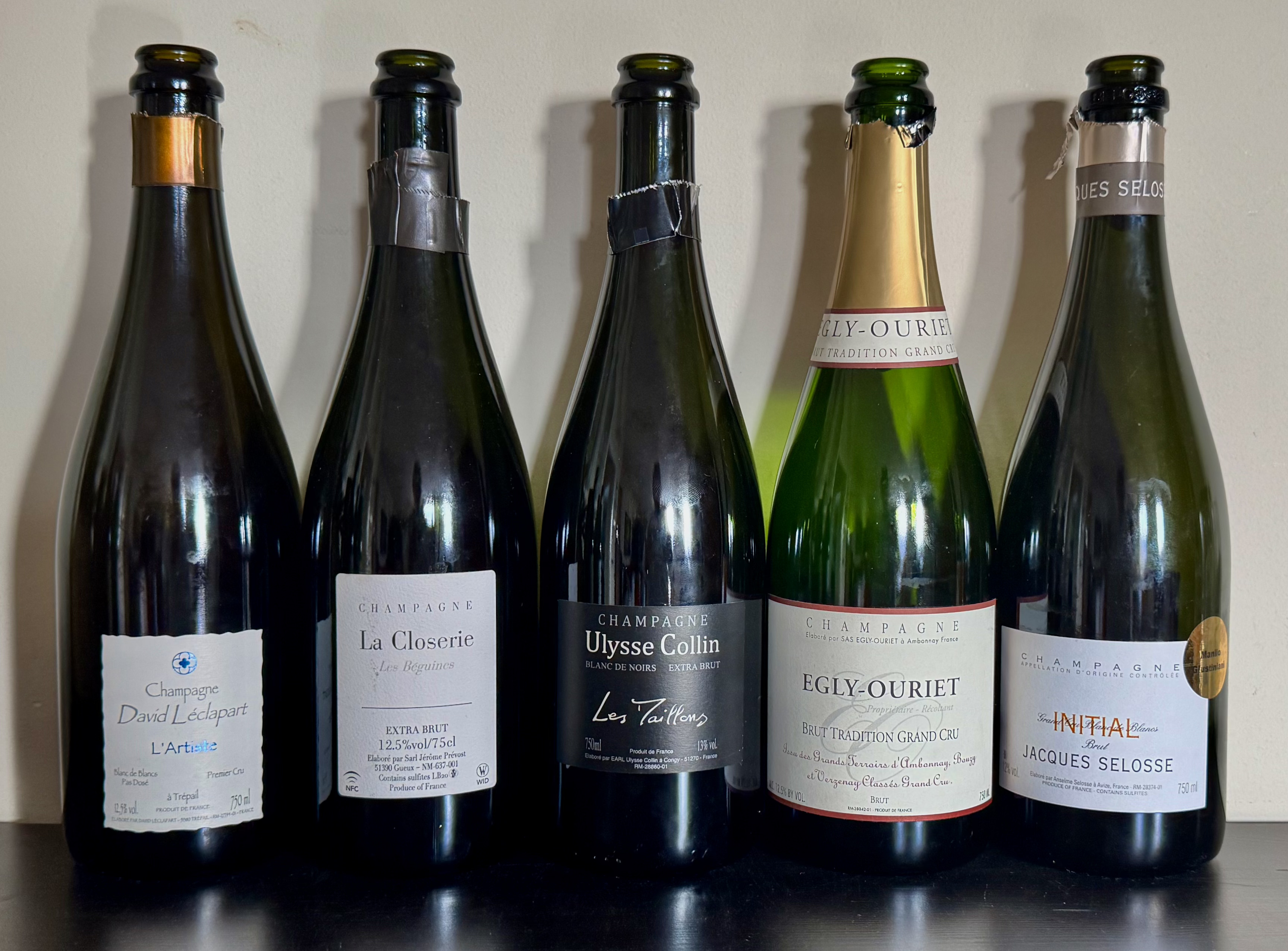
Five interpretations, five aesthetics, yet a single trajectory: the return to the vineyard as a place of truth, the parcel as an identity key, aging as necessary time, and coherence as a form of responsibility.
Tiziana Mirabella
Tasting led by Manlio Giustiniani.
Tags: DavidLéclapart, LaCloserie, UlysseCollin, EglyOuriet, JacquesSelosse